
Base Oil Groups Explained
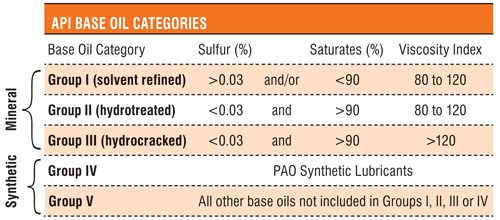
Almost every lubricant used in plants today started off as just a base oil. The base oil category defines what the oil is made of, how it is manufactured, and how the lubricant handles certain environments such as extreme heat.The American Petroleum Institute (API) has categorized base oils into five categories (API 1509, Appendix E). The first three groups are refined from petroleum crude oil.
Group IV base oils are full synthetic (polyalphaolefin) oils. Group V is for all other base oils not included in Groups I through IV. Before all the additives are added to the mixture, lubricating oils begin as one or more of these five API groups.
GROUP 1
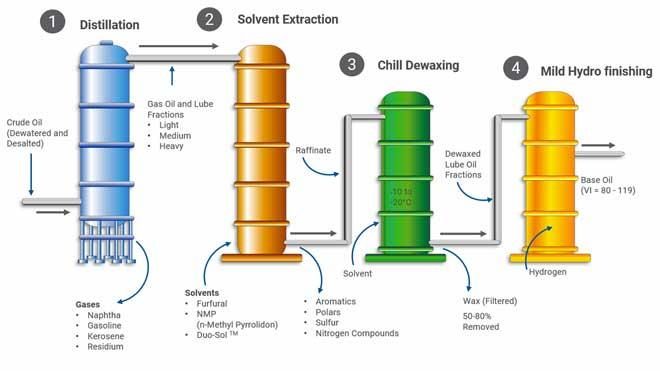
Group I base oils are classified as less than 90 percent saturates, greater than 0.03 percent sulfur and with a viscosity-index range of 80 to 120. The temperature range for these oils is from 32 to 150 degrees F. Group I base oils are solvent-refined, which is a simpler refining process. This is why they are the cheapest base oils on the market.
GROUP 2
Group II base oils are defined as being more than 90 percent saturates, less than 0.03 percent sulfur and with a viscosity index of 80 to 120. They are often manufactured by hydrocracking, which is a more complex process than what is used for Group I base oils. Since all the hydrocarbon molecules of these oils are saturated,
Group II base oils have better antioxidation properties. They also have a clearer color and cost more in comparison to Group I base oils. Still, Group II base oils are becoming very common on the market today and are priced very close to Group I oils.
GROUP 3
Group III base oils are greater than 90 percent saturates, less than 0.03 percent sulfur and have a viscosity index above 120. These oils are refined even more than Group II base oils and generally are severely hydrocracked (higher pressure and heat). This longer process is designed to achieve a purer base oil.
Although made from crude oil, Group III base oils are sometimes described as synthesized hydrocarbons. Like Group II base oils, these oils are also becoming more prevalent.
GROUP 4
Group IV base oils are polyalphaolefins (PAOs). These synthetic base oils are made through a process called synthesizing. They have a much broader temperature range and are great for use in extreme cold conditions and high heat applications.
GROUP 5
Group V base oils are classified as all other base oils, including silicone, phosphate ester, polyalkylene glycol (PAG), polyolester, biolubes, etc. These base oils are at times mixed with other base stocks to enhance the oil’s properties. An example would be a PAO-based compressor oil that is mixed with a polyolester.
Esters are common Group V base oils used in different lubricant formulations to improve the properties of the existing base oil. Ester oils can take more abuse at higher temperatures and will provide superior detergency compared to a PAO synthetic base oil, which in turn increases the hours of use.
Groups 1-3 are not synthetic oils.
Groups 4 & 5 ARE true synthetic base stocks. These are what engine oils and other lubricants are built on to ensure maximum protection, longevity, and durability.
Thanks to machinerylubrication.com for this in depth analysis.
DO YOU KNOW...
What the difference is between FULL SYNTHETIC and 100% SYNTHETIC?
THE TRUTH: Engine oil labeled as FULL SYNTHETIC likely is not actually so. Under the historic MOBIL VS CASTROL lawsuit, any motor oil built on base group 3 can legally be called 'synthetic.' The problem? Group 3 is still a hydro-cracked oil, being pulled from the earth. It's a conventional oil. True synthetic oils are formed from base group 4 PAO & group 5 esters. This means most of the options on store shelves and at most shops are not really a true synthetic oil... they are actually a conventional blend!
The term 'Full(y) Synthetic' is just a marketing term similar to 'Dr. Approved' or '4 out of 5 moms prefer.' It started as a litigation compromise created by lawyers that can mislead most people into buying inferior products that won't live up as promised, wears out equipment faster, and costs more money & aggravation in the long run.
And you know what?
We think that's legal garbage. Because of that, nearly all of the lubricants, fluids, and ALL of the engine oils we sell and stand behind are true Synthetic products that are engineered for the best possible protection, performance, and durability.
Check out this video above. It explains why it is so important to have quality, 100% synthetic lubricants.
Think about this: A new engine on a later model vehicle can cost in excess of $7500 for a car or cossover, and upwards of $20,000 for pickups or family size SUV's. A transmission can approach $10,000. Differentials, hydraulics, and transfer cases can also see four-figure repair costs. Now compare that with the price of something like... a simple oil change.
Example: Lets say that quick-lube oil service costs you $65. Because it's a 'full synthetic' (base group 3) it's good for realistically about 5,000 miles. But when you use a top-pier 100% Synthetic oil you can easily double that to 10,000+ miles without worry for starting around $85. By making that smart decision, you just saved money AND provided the actual best protection for your vehicle.
Regular routine maintenance using high quality products is clearly a less expensive option.